Invitation
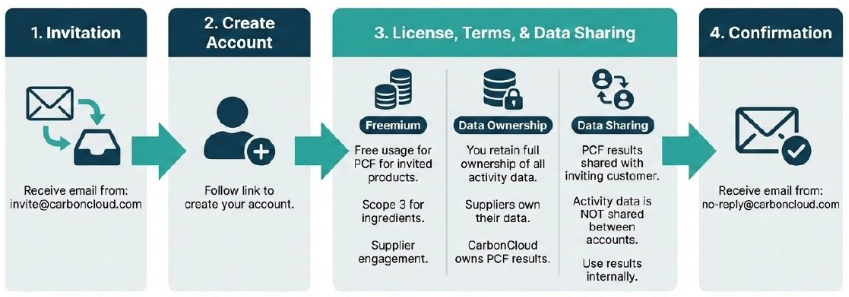
Your PCF reporting journey begins when you receive an invitation from CarbonCloud, sent on behalf of your producer, asking you to create an account.
After setting up your account, you can access the reporting platform and view the PCF calculations for your products.
Adding data
Initially, you will see PCF values based on secondary data. Secondary data refers to industry averages or statistical data used when primary data—data measured or collected directly from your own operations— is not yet available.
As you begin to submit primary data the platform automatically updates the calculations. As the secondary data is replaced, the product’s climate footprint is recalculated.
These updates apply across the connected value chain so that all participants work with the most accurate available information.
Expand the network and improve data accuracy
If you have suppliers further upstream in the value chain, you can invite your suppliers to contribute their data, to build a more accurate carbon footprint. These may include raw material providers, input suppliers, distributors, or other parties in the value chain. The platform allows you to send invitations directly to your suppliers.
The platform allows you to send invitations directly to your suppliers. Each supplier can then add their own primary activity data and invite their suppliers in turn.
Over time, this creates a connected network where supplier specific primary data gradually replaces statistical benchmark data across more stages of the value chain.
This network model allows downstream (later stages in the value chain) calculations—such as processing, packaging, distribution, or retail—to build on the data reported upstream (earlier stages in the value chain) in agriculture and raw material production.
Track supplier participation and improve data quality
As more actors in the product’s value chain contribute data, the product's Primary Data Share (PDS) increases.
Primary Data Share indicates how much of the PCF calculation is based on real operational data rather than estimates.
Your view in the platform updates automatically, allowing you to:
- Follow how supplier participation increases over time
- Monitor updates to emission values
- Review a change log showing when data has been updated for each product
This transparency helps improve both data quality and collaboration across the value chain.
Reporting and updates
You can update your emission data in the platform whenever new or improved information becomes available.
The “draft and publish” functions allow you to review changes before they are shared across the network. This ensures that updates are intentional and clearly documented.
Other participants in the value chain can then see when a product’s PCF has been updated and confirm that the calculation is based on the most recent available data.
Understanding your PCF results
After entering your data in the CarbonCloud platform, you can review and interpret your PCF results.
Your PCF result shows:
• The total climate impact of your product
• How different life-cycle stages contribute to the footprint
When values are adjusted in the platform, the PCF calculation updates automatically. This allows you to see how changes affect the overall result and helps identify key emission drivers. Understanding these results makes it easier to focus improvement efforts where they can have the greatest impact.
On the CarbonCloud platform, there is a brief guide intended to help you understand the meaning of the various carbon footprint breakdown figures presented on the platform.
The PCF generated through Systembolaget’s services with CarbonCloud can be used by suppliers for internal purposes.
Data ownership and privacy
You retain full ownership of the activity data you submit. When PCF results are updated across the value chain, only aggregated results are shared. This means that the calculated product footprint is visible, but detailed operational data from individual suppliers is not shared unless explicit permission has been given.
Learn more about how data is handled here:
Data Handling & Privacy